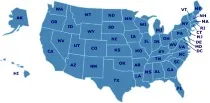
The greatest obstacle pioneering homeschoolers faced two decades ago was daunting: in most states home education wasn't legal. This article details five of the most significant cases that have become landmark decisions in the move towards homeschooling freedoms: the DeJonge case in Michigan, the Jeffery case in Pennsylvania, the Diegel case in Ohio, the Triple E case in South Carolina, and the Calabretta case in California.
Parents Educating at Home (PEAH) has as its goal to network with businesses and organizations to raise the awareness of home schooling in the community. They work to manage and communicate discounts and savings that home schooling families can receive as well as continually work to obtain additional discounts both nationally and locally on behalf of the homeschooling community. In order to become a member, you must pay a fee.
ThinkQuest is an international student competition, sponsored by the Oracle Education Foundation. Students work in teams to build creative and educational websites that explore globally relevant subjects. Diverse teams made up of members from more than one school, community, or country are encouraged. Competitions are open to students and teachers from anywhere in the world. Teams must have 3 to 6 students who are between the ages of 9 and 19, and one adult Coach who is a school employee. Homeschooled students may participate so long as they are part of a team that is associated with an accredited public, private, or parochial school (i.e., Primary Coach is an employee of an accredited public, private or parochial school and other team members are affiliated with an accredited school). Homeschooled students might consider forming a team with students from another country. Being a member of a multi-country team presents a great opportunity for all students to learn about other cultures and to learn valuable collaboration skills. The completed websites are published in the ThinkQuest Library, a rich learning resource used by millions.
Stacy Mantle discusses seven specific types of learning styles: linguistic, logical, spatial, musical, bodily, interpersonal, and intrapersonal.
Offers BRIGANCE Screening and Inventories products. Designed for use in elementary and middle schools, the CIBS-R is a valuable resource for programs serving students with special needs, and continues to be indispensable in IEP development and program planning.
Little is known of Canadians who were home educated as students, particularly as they compare to their Canadian adult peers who were educated in publicly-funded and private schools. Are they as engaged as their peers in democratic, cultural, and economically productive activities? How do their income levels and income sources compare? Are they more or less likely to pursue postsecondary education, to be involved in their communities, to be physically active? How do they evaluate the advantages and disadvantages of their home education experience? This study provides a demographic and lifestyle snapshot of these young adults and offers an initial description of some of the indicators of the outcomes of the first generation of home education in Canada. The study followed up with Canadian survey participants fifteen years after they first shared information about their home education practices, family demographics, and academic achievements (Ray, 1994). It describes their current education level, occupation, community participation, religious observance, income, life satisfaction, recreational pursuits, and family status, and compares these with those of the general adult population of Canadians in the same age group. We also asked graduates to reflect on their home education experience and how it prepared them for their future.
Field trips can inspire your child to study a topic, give him further insights into his current studies, or provide closure to a completed unit. Is there somewhere you’d like to take your children to reinforce a topic this year? Or just want to visit because it would enrich their lives? If you let your support group (or even just a few other families) know that you are planning to go and they are welcome to tag along (think: group rate)—voila! You’re planning a field trip!
This policy paper provides a list of questions that parents and parent organizations can address in an effort to ensure that statewide assessment systems fully and fairly include students with disabilities. In the past, students with disabilities have too often been excluded from large-scale assessments. However, students with disabilities now must be included in state assessment programs with appropriate accommodations, as required by the recent amendments to the Individuals with Disabilities Education Act (IDEA), as well as the Americans with Disabilities Act (ADA), and Section 504 of the Rehabilitation Act of 1973.